
A Visual Theology
Among the 7,000 or so items in the Haehn Museum are the makings of countless exhibits, yet the most famous and inquired about are the needlework pieces. Many are adorned with religious symbols and used in items which skilled hands, creative minds and very patient women created. These creations were made of dazzling colors and intricate designs on precious fabric — creations to give glory and praise to the Creator of all. Since the sisters were always about teaching the faith which can hardly be pictured, symbols became the language of the Divine; symbols woven in stitches were the primer of faith education. These creations are the focus of the Haehn Museum’s newest exhibit, “A Visual Theology: Symbols Woven in Stitches.”
In 1892, Sister Justina Knapp became the director of the monastery’s Art Needlework Department. For 40 years, she was the motor, fuel and spark of the department. Though she had only a fourth-grade formal education, her interest, curiosity and skill made her a lifelong learner.
S. Justina often asked her brother, Father Raphael of Saint John’s Abbey, Collegeville, Minn., who traveled to Europe several times, to bring her books. He complied, and since he studied at the Benedictine Archabbey of St. Martin in Beuron, Germany, the books he brought to S. Justina contained much of that art. This influence
S. Justina acquired a sizeable library and learned the profound meaning of symbols which she defined as “the representation of a moral or intellectual trait which cannot be pictured.” As a very young sister, she had taught in a parochial school in Duluth, Minn., for 12 years, and she never lost her love of and dedication to teaching. S. Justina actually created a children’s coloring book of basic Christian symbols in the midst of her years within the Art Needlework Department. She encouraged all of the needle arts and continued to study the official documents of the Church concerning ecclesiastic art.
While training other sisters in needlework, S. Justina guided the vestment department and drew nearly all of the patterns for the work of the department. Between 1867 and 1968, almost 50 sisters worked for some amount of time in the department. Orders for vestments, banners, church adornments and even mending of church vesture came to the department from Minnesota, the Dakotas, Wisconsin, Canada, much of the upper Midwest and even from Europe! The venture did prosper financially and helped to fund a new building, Walburg Hall, which provided appropriate space for the department and housing for members of the growing community.
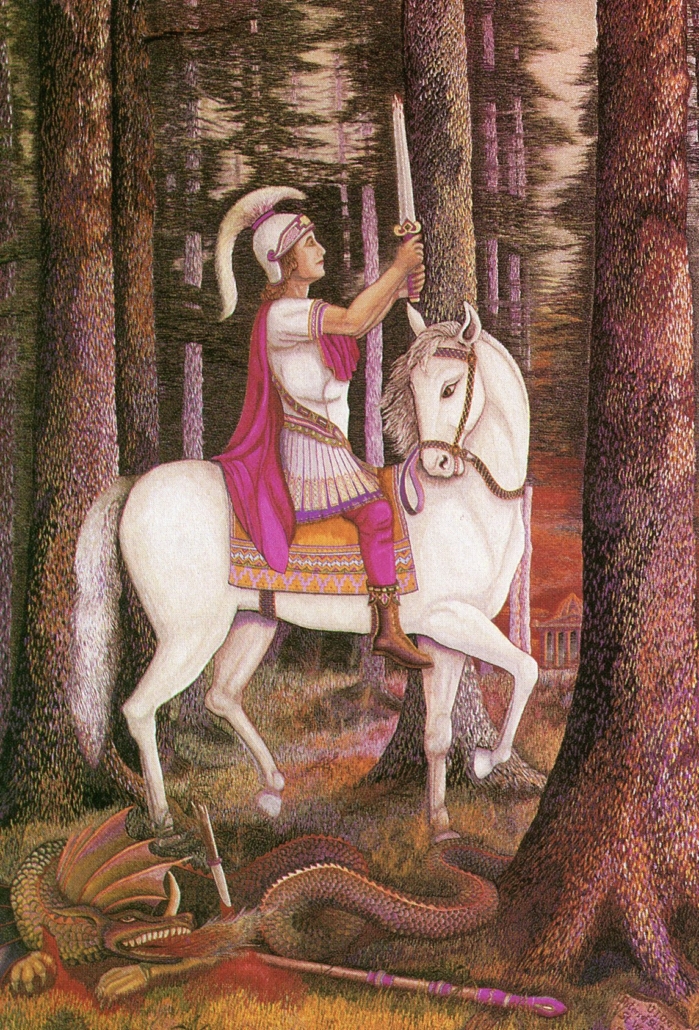
One of the major pieces designed by S. Justina is a Pentecost scene, complete with Mary, the mother of Jesus, in the center surrounded by all 12 apostles — each with a unique face, hairline and robe — as they receive the tongues of fire signaling the descent of the living Holy Spirit. Probably the most famous of her creations, which was embroidered singlehandedly by the very gifted Sister Bernadita Brauckmann in 1929-1930, is the tapestry of Saint George and the dragon. George is a favorite, measuring 24” x 38” and housed in a plexiglass case that allows the front and back of the piece to be seen. The piece was made and sent to a Mr. George Hutter as appreciation for his work as a general contractor for the St. Cloud Hospital. The letter accompanying the gift stated that the sisters believed “divine providence” had brought him to Minnesota when they needed a talented and creative person to guide the construction of the hospital on the shore of the mighty Mississippi River.
In the midst of the years when many patterns were needed to respond to the growing orders at the department, S. Justina produced her book Christian Symbols and How to Use Them. The book became a classic addition to the theology of ecclesiastical art. In 2007, it was republished by Kessinger Publishing, LLC. Because the quality of the paper had diminished with time, there is a disclaimer at the beginning of the book stating that, “Because this is such an important and rare work, we believe it is best to reproduce this book regardless of its original condition.”
In 1968, the Art Needlework Department formally closed, and it is often thought to be a formative force in promoting the liturgical revival of the 1970s and beyond.
Judy Kramer, OSB
This article was featured on pages 18-19 in the spring 2026 issue of Benedictine Sisters and Friends.
To view dozens of stunning pieces from the historical Art Needlework Department, visit the Haehn Museum’s current exhibit, “A Visual Theology: Symbols Woven in Stitches.”
Regular Hours
Tuesday-Friday: 12-4 p.m.
Saturday: 10 a.m. to 3:30 p.m.
Closed Sunday and Monday
Visits outside regular hours are arranged as requested. For more information, contact Sister Judy Kramer, director of the Haehn Museum, at 320-363-1605.


