
Tidbits From the Past
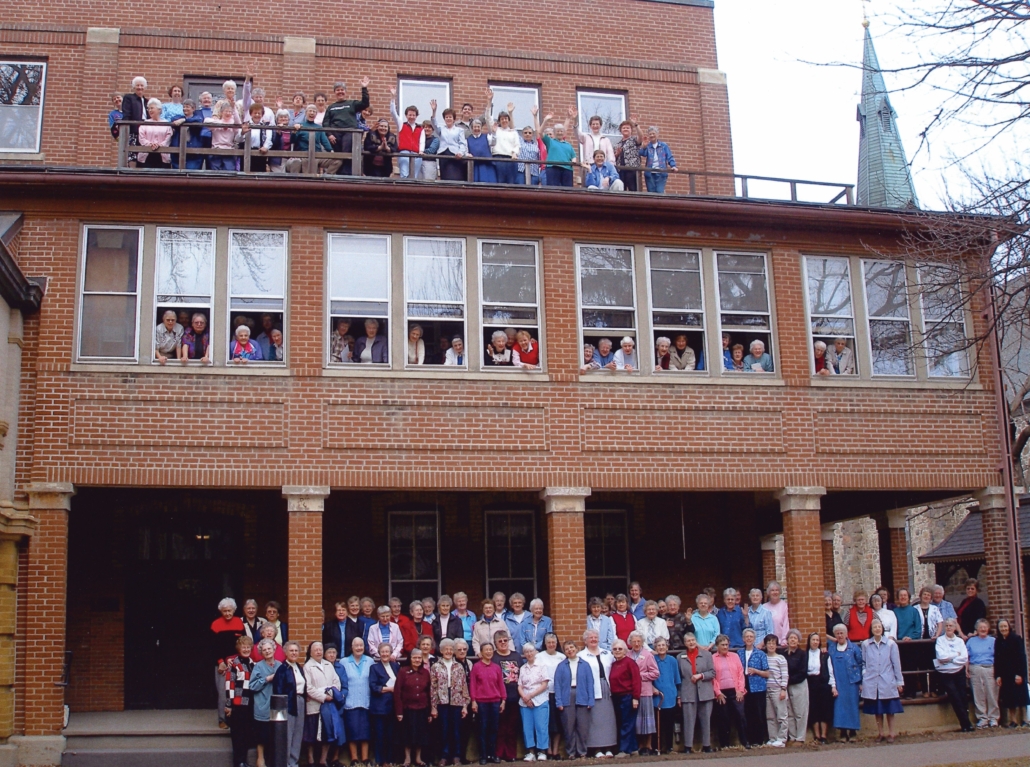
St. Benedict’s Rule urges the abbot or prioress to seek counsel from the community members — for, as he wrote, “The Lord often reveals to the younger ones the wisest course to take” (Rule of Benedict 3:3). Benedictines have traditionally — in varying degrees — utilized Councils and Chapters to assist leadership in planning a community’s immediate and long-range development. The term “discernment” became common particularly after Vatican II with our sisters embracing the concept personally and as a community in order to listen to one another with the guidance of the Holy Spirit. Our community began a steady process of frequent and prayerful sharing of collective wisdom to envision a continued vibrant monastic life.
The 1970s was a major turning point for this community: a shift in understanding its own evolution and relationship to ministries. Decline in membership brought further study as finances and the rapid aging of the sisters added new challenges and questions. In October 1971, Sister Nora Luetmer became the community’s first director of planning and research. She focused on a study of the community’s varied apostolates. Her final report, listing decisions facing the community, was the basis for future planning. A Process Implementation Team, established in 1973, worked out structure for a Senate (originally a Synod) to assist the Council and the Chapter in their planning for the future.
By the late 1970s, S. Nora’s original study (filled with statistics!) needed updating. A comprehensive planning program was needed, and in the 1980s, a planning committee was set up with Sister Firmin Escher as coordinator of research and planning. The first major project was the renovation of Sacred Heart Chapel (1980-83), which expanded to include a Gathering Place and an Archives. Clearly, the first goal in the ‘80s was to review current apostolic works and envision possible future priorities. Numerous task teams were set up, responsible for subdivisions of planning.
Grassroots participation increased. Area meetings were held wherever our sisters were living and working, sometimes three or four missions combining to discuss specific issues. Workshops were held, at which information could be shared as well as brainstorming for more and new options. Study and discussion reports went directly to the prioress and her Council. Most often, these reports were summarized and then presented to the Chapter for a final decision on policy and procedure.
By the early 1990s, there were at least 13 task teams and ad hoc groups studying and discussing aspects of community life and the need for changes in direction. Among these task teams were Buildings and Renovations, Global Awareness, Library Resources, Liturgy Revisions and Lifelong Formation. Flow charts became a staple during these years! In 1990-91, “Core Issues of Our Monastic Life” surfaced as a focal point, and areas of community living and outreach were central in future planning. And, in 1994, the Chapter approved a Comprehensive Facilities Plan to zero in on specific projects.
Many listening sessions and renewal discussions were held. Minutes from these proceedings reveal detailed discussions at all levels of the community — anticipating the dawn of a new century. Major construction programs emerged. By repurposing existing buildings, Saint Scholastica Convent was built in St. Cloud, Minn., as a retirement home for our elder sisters and those needing more medical assistance. At the motherhouse, renovations of the Main Building, Rosamond Hall and Walburg were undertaken. A new Marmion was built.
Post-2000 saw constant envisioning of how the community could develop further in its structure and ministries. Many groups assisted the Planning Office, including Monastery Sites and Facilities, Social Justice, Community Worship and Membership/Admissions. “Strategic planning” became a mantra as facilitators’ meetings and workshops proliferated. The sisters became more involved in community programs, interacting with one another at a pace and scope unprecedented in community history. Setting the community’s trajectory became a total community endeavor.
As prioress from 1961-73, Mother Henrita Osendorf set the tone for all this research and decision making. She wrote: “Calm and tranquility of spirit are the characteristics of religious whose preoccupation is with basic elements. They do not fear change because they know that they have penetrated to the heart of the matter and are secure in that knowledge.” Decades after her words of encouragement, our community has indeed met and accepted the challenges facing us — collectively.
Carol Berg, OSB
This article was featured on pages 12-13 in the spring 2026 issue of Benedictine Sisters and Friends.


